
How long does a 5 kWh battery last?
Calculate the indicative runtime of a 5 kWh battery based on appliances, reserve, losses and the backup power actually available.
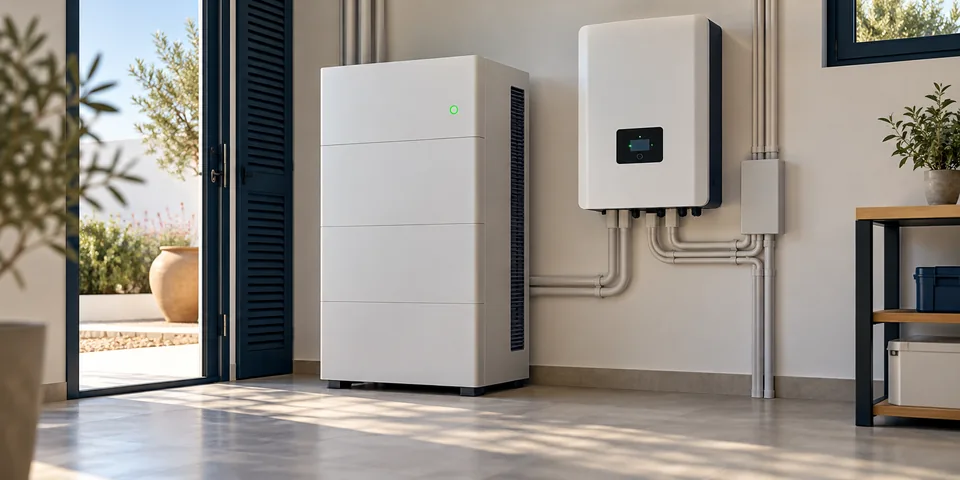
It depends on available energy and the appliances being powered. A battery rated at 5 kWh does not mean five hours for every use, or 5 kW of power. Planning backup requires two answers: how much does the priority circuit consume, and how long must it run?
Key points:
- kWh measures an amount of energy; kW measures power.
- Runtime is calculated from usable energy after relevant reserves and losses.
- Motor startup demand and inverter power are checked separately.
Fictional examples, checked on 31 October 2026, to explain the method before your installation assessment.
1. Start by distinguishing kW from kWh
An appliance drawing 1 kW for one hour uses 1 kWh. Two appliances of the same power running together require 2 kW. Storage must therefore provide enough energy for the planned duration and enough power while the appliances are running.
The Department of Energy distinguishes these two characteristics and highlights storage losses. This physical explanation is not a Tunisian grid-connection rule. Source: principles of solar storage.
2. How much of the 5 kWh remains available?
Take a battery with 5 kWh of nominal capacity, assumed fully charged when the outage starts. Our example keeps a 20 % reserve and assumes 90 % discharge efficiency to the appliances.
The calculation is: 5 × 80 % × 90 % = 3,6 kWh available to loads.
The 80 % already represents the selected discharge range. A second 20 % reserve must therefore not be subtracted. Similarly, if the manufacturer states usable capacity or a result measured on the AC side, understand what is already included before applying extra factors.
3. Three runtimes from the same energy reserve
With 3,6 kWh available, no solar input during the outage and ignoring the system’s auxiliary consumption:
| Average power of backed-up appliances | Calculation | Theoretical runtime |
|---|---|---|
| 500 W, or 0,5 kW | 3,6 ÷ 0,5 | 7 h 12 |
| 1 000 W, or 1 kW | 3,6 ÷ 1 | 3 h 36 |
| 2 000 W, or 2 kW | 3,6 ÷ 2 | 1 h 48 |
These durations vary with initial charge, temperature, ageing and load changes. A partially charged battery at the start of an outage does not have the same reserve. To compare technologies, also read gel or LiFePO4 lithium.
Your free, no-obligation assessment starts with priority appliances and desired duration. The team helps you fill in any missing details.
4. An average load does not describe every peak
A refrigerator, pump or motorised appliance may require different power at startup. Adding up energy in kWh is therefore not enough to choose the inverter and battery.
NREL’s guide to operating solar PV and storage systems also distinguishes energy capacity from power delivery capacity. For a project, these limits must be compared with actual load profiles. Source: NREL, operations and maintenance guide, third edition.
The assessment records appliances used simultaneously, power peaks, number of phases and equipment that can or cannot tolerate a brief interruption. Backing up an entire building requires a different analysis from backing up a few essential circuits.
5. How should you prepare the appliance list?
Make a simple list: appliance, stated power, desired duration and priority. For equipment with variable consumption, measurements or manufacturer documentation will help.
| Information | Example question |
|---|---|
| Priority | Must the till, IT network or refrigeration remain available? |
| Operation | Does the appliance run continuously or in cycles? |
| Simultaneous use | Which appliances start or run together? |
| Duration | Do you need one hour, four hours or an orderly shutdown? |
| Continuity | Can this appliance tolerate a brief interruption? |
In a business, distinguish what enables limited service from what is needed for full operation. This classification can significantly change the backup budget.
6. Can you rely on sunlight during an outage?
Solar recharging during an outage can extend operation if the planned architecture allows it. It also depends on sunlight at the time and active equipment. A prudent backup calculation must consider an evening outage or insufficient solar generation.
Panels and a battery alone do not define the backup function. SMA explains that power during an outage depends on the equipment combination and the configuration designed for that operation. Source: solar and grid outages.
7. Work backwards from desired duration to capacity
Assume an average demand of 800 W for four hours: 0,8 × 4 = 3,2 kWh must be delivered. Using only the previous usable-range and efficiency assumptions, the nominal reference becomes 3,2 ÷ (0,8 × 0,9) ≈ 4,45 kWh.
This result is a mathematical minimum in this simplified scenario. Peaks, auxiliary consumption, operating conditions and the desired reserve still need checking. Equipment selection then requires its precise documentation and an installation assessment.
8. Prepare your project with the right data
Add your appliance list to your STEG bill. If you already have panels, also provide your inverter model: adding a battery to an existing installation depends on this architecture.
: provide your name, phone number and email so we can contact you. Our other solar PV guides help you prepare your project.