
Gel or LiFePO4 lithium battery: compare usable energy
Compare gel and LiFePO4 lithium for solar storage: usable energy, power, cycles, compatibility and cost of delivered service.
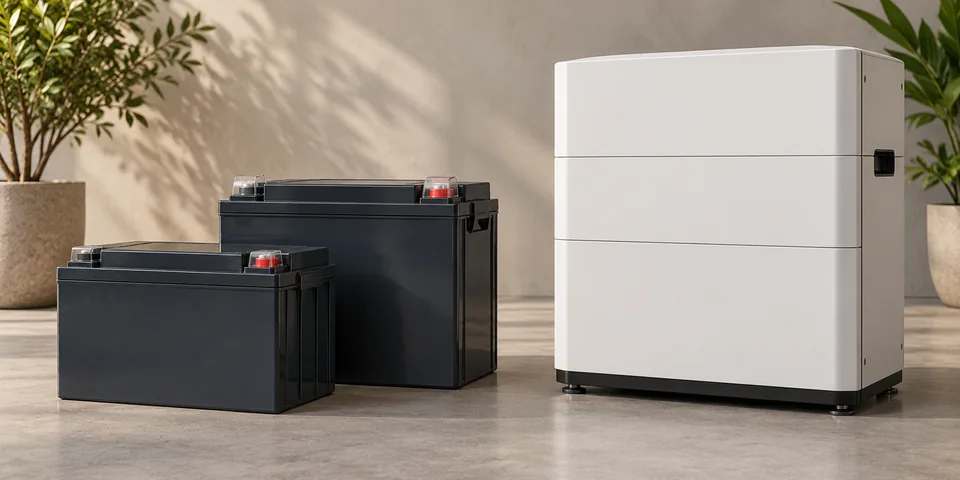
The best choice depends on use: occasional backup, daily solar storage, appliances to power and desired duration. Battery price and ampere-hours are not enough. Compare complete systems capable of delivering the same service.
Three points to help you choose:
- Compare available kWh and system output power.
- Ask about the conditions behind advertised cycles, warranty and temperature limits.
- Check the battery, inverter, electronic management and backup function together.
Information checked on 31 October 2026. Illustrative examples, with no commercial product reference or guaranteed backup duration.
1. Gel and LiFePO4: two technologies to assess
A gel battery belongs to the lead-acid family with an immobilised electrolyte. LiFePO4 is lithium iron phosphate chemistry, one of the lithium-ion technologies. “Gel” and “lithium” are therefore not simply two quality levels of the same product.
Datasheets detail capacity, discharge rates and operating conditions. For example, Victron’s GEL/AGM documentation distinguishes behaviour by discharge and temperature: a capacity figure must be read alongside its conditions. Source: manufacturer GEL and AGM datasheetPDF document in French.
Start your project with a concrete need: keeping the router and lights on, backing up a refrigerator or powering several circuits during an outage. The service required gives the comparison meaning.
2. Ampere-hours are not enough
Capacity in Ah must be combined with nominal voltage to obtain energy. For example, 12 V × 200 Ah = 2 400 Wh, or 2,4 kWh of nominal energy. At a different voltage, the same Ah rating represents a different amount of energy.
This nominal energy is not necessarily what reaches your appliances. Consider the charge range used, conversion losses and operating conditions. If a datasheet already states usable capacity, do not subtract the same reserve a second time.
Our 5 kWh battery runtime guide explains how to move from stated capacity to operating hours.
3. An example comparing the same service
Imagine two systems with 5 kWh of nominal capacity. To explain the method, assume a usable range of 50 % for system A and 80 % for system B, with 90 % discharge efficiency in both cases.
| Illustrative assumption | System A | System B |
|---|---|---|
| Nominal energy | 5 kWh | 5 kWh |
| Fraction used in the example | 50 % | 80 % |
| Estimated deliverable energy | 2,25 kWh | 3,60 kWh |
| Constant load of 500 W | 4 h 30 | 7 h 12 |
These parameters explain the calculation; 50 % and 80 % are not universal recommendations for every gel or lithium battery. The quotation must reflect the limits of the selected model. Two identical nominal capacities can therefore produce different results for the same backup need.
Specify the appliances you want to keep running and the duration required. Your free, no-obligation assessment request lets the team define your storage needs with you.
4. Advertised cycle counts come with conditions
A cycle count must specify depth of discharge, temperature and the remaining-capacity threshold used. In a LiFePO4 range documented by Victron, published values vary with cycle depth. This illustrates why a standalone number cannot compare two quotations. Source: Lithium Smart technical data.
Occasional backup use and daily discharge do not put the same demands on a battery. Cycle-related wear must also be distinguished from ageing over time. A warranty in years, a design life and a cycle count are not interchangeable commitments.
5. Heat, location and electronic management
The location must comply with equipment documentation on temperature, ventilation, humidity, access and protection. Strong heat can affect operation and ageing. The assessment must account for the actual location, not just a nominal value measured under controlled conditions.
For the lithium systems concerned, electronic cell management and its integration with the inverter are part of the choice. The Lithium Smart manual shows that charge and discharge limits and BMS functions depend on the architecture used. Source: manufacturer manual, operation.
6. The relevant price is for the complete system
Compare the same backup duration, appliances and scope: battery, conversion, protection, distribution-board modifications, installation, follow-up and planned replacements. A cheaper battery may need a different capacity to deliver the service required.
Ask for the exact model, usable energy, continuous power, allowable peaks, warranty conditions and maintenance tasks. The warranty and maintenance guide helps structure this comparison.
7. In Tunisia, also check the project framework
STEG has published authorisation for its residential customers to use batteries paired with hybrid inverters. The project must still be reviewed against technical requirements and accepted equipment. Foreign sales documentation does not amount to local acceptance of a battery-inverter combination. Source: official STEG announcement.
If you already have panels, also read what to check before adding a battery.
8. Prepare a comparison tailored to your usage
To start, prepare your bill, list of priority appliances, their power ratings and desired backup duration. If you do not know these details, the team helps you complete them. Project financing is assessed separately from the technical choice.
: leave your name, phone number and email so we can contact you. Find more explanations in Advice and case studies.