
Can you add a battery to an existing solar installation?
Can your installation take a battery? Compare system architectures, compatibility, backup functionality and STEG checks.
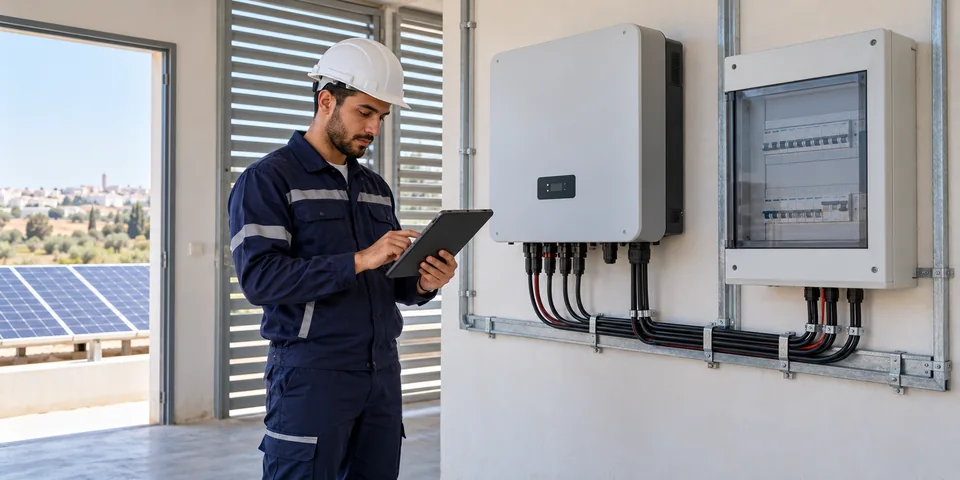
It is possible in many projects, after checking the equipment and connection. Adding storage is not just about choosing a capacity in kWh. The inverter, battery, protection, energy management and desired behaviour during an outage must all be assessed.
Three starting questions:
- Do you want to shift solar use to later, have backup power, or both?
- Which inverter and protection devices are already installed?
- Which appliances must run during an outage, and for how long?
Information checked on 31 October 2026. The architectures presented help prepare an assessment; they are not wiring instructions.
1. Define the expected outcome
Storing some solar energy for later use and providing backup during an outage meet different goals. A battery used during the day or evening may not be sufficiently charged when an outage occurs.
The assessment must therefore specify the desired backup reserve, usage priorities and recharging conditions. In a home, this may cover lighting, connectivity and certain appliances. For a business, assess the equipment needed to continue service or shut it down in a controlled way.
2. Identify your current installation
Gather the model references shown in the quotation and commissioning documents. Clear photos of nameplates, taken without opening equipment, can help the team prepare for the discussion.
| Useful data | Why it matters |
|---|---|
| Exact inverter model | Identify available functions and compatible equipment. |
| Solar array capacity and configuration | Check the existing system and upgrade options. |
| Single- or three-phase connection | Review circuits and load distribution. |
| Documented electrical panel and protection devices | Prepare the technical visit and required modifications. |
| Production and consumption history | Assess when a battery could be charged and used. |
Your STEG bill and its consumption period complete this information. A visit is still required to check the installation’s actual condition.
3. Two main architectures to compare
One approach is to keep the PV inverter and add dedicated battery conversion on the AC side, commonly called AC coupling. Another uses a hybrid inverter that manages PV and a compatible battery on the DC side. Whether the inverter needs replacement or adaptation depends on the equipment already installed.
SMA presents these two routes for upgrading an installation. This explanation describes architectures; available models, compatibility and acceptance in Tunisia must be checked for the project. Source: SMA, battery inverters and adding storage.
| Comparison point | What the assessment should examine |
|---|---|
| Keeping existing equipment | Equipment reused, replaced or added. |
| Conversion and management | Energy paths, losses and equipment coordination. |
| Backup function | Circuits covered, available power and transfer conditions. |
| Total cost | Equipment, modifications, installation, checks and follow-up. |
Mention that you already have a system and attach the available model references. The team prepares a free, no-obligation assessment with you.
4. “Hybrid” does not fully describe backup operation
Check the function provided for a grid outage: which circuits are powered, at what power, with what transfer and under what charge conditions? Sensitive equipment may have specific limits on acceptable interruption.
The architecture must maintain appropriate separation from the grid during standalone operation. STEG’s July 2026 reference covers requirements for low-voltage PV installations, including storage and related equipment. Source: STEG technical reference, July 2026.
A battery therefore does not prove that an entire business will remain powered in every situation. The backup scope must be written into the technical proposal.
5. The battery-inverter combination must be compatible
The assessment compares voltage, allowable power and currents, management functions, required interfaces and hardware or software versions. Advertised compatibility for a product family does not replace checking the exact model.
STEG publishes a list of hybrid inverters accepted for low-voltage connection. A listed brand does not mean every model is accepted: check the reference, conditions and validity, then confirm the position when submitting the application.
6. Procedures depend on the project
STEG announces authorisation for residential customers to install batteries paired with hybrid inverters. For an installation modification or professional use, connection conditions and the applicable application must be checked with the relevant services. Source: official announcement on domestic storage.
The project therefore includes an administrative check alongside the technical assessment. Compliance of a complete installation cannot be inferred from a single equipment datasheet.
7. Compare the complete proposal
Ask what will be kept and added, which circuits will be backed up, the usable energy, available power and planned acceptance tests. Clarify the respective warranties on the existing installation and added equipment, and who is responsible for follow-up.
The gel and LiFePO4 lithium comparison and 5 kWh battery runtime calculation help you review the proposal. Selection and installation work should be entrusted to qualified professionals, based on the chosen equipment.
8. Prepare the next step
Your bill, inverter model references and list of priority appliances are enough to start the discussion. The application is then completed through the visit, checks and costing.
: leave your name, phone number and email for a callback. Browse the guides and calculation examples to continue preparing your project.