
Fridges, display cases and freezers: what backup does your business need?
Size backup power for commercial refrigeration: consumption, compressor start-up, runtime, recharging and temperature monitoring.
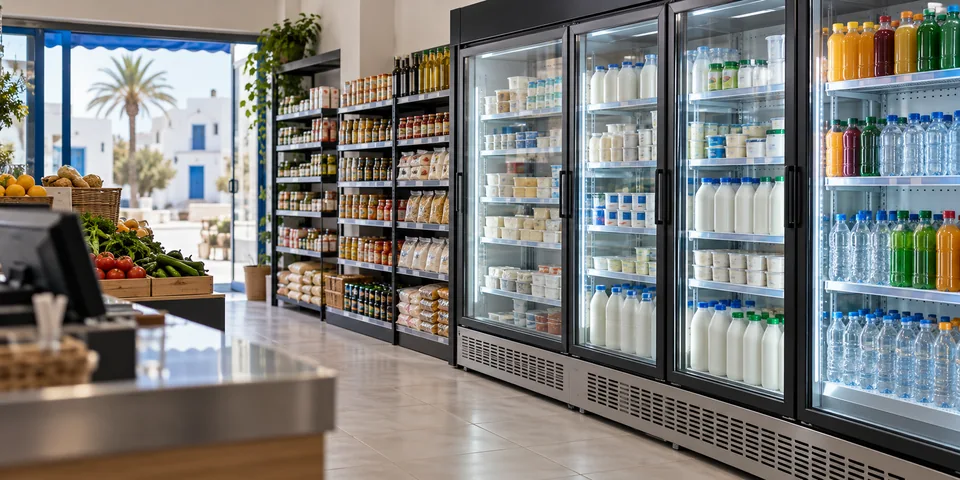
A battery can power refrigeration equipment during an outage if its capacity, power and the overall system are suitable. The electrical assessment complements cold-chain monitoring; it does not replace temperature records or your business’s hygiene procedures.
For a convenience store, café or food-service business, start with an inventory of refrigerated units to protect. Product quantities, door openings and room conditions then influence actual demand.
Three essential parameters: energy consumed over the target duration; power required for startup; charge available at the start of the outage.
1. Measure cycles, not just a power rating
A compressor runs in cycles. Its nameplate power therefore does not directly give its average consumption over four hours. Defrosting, fans, display lighting and any heating elements must also be identified.
Have consumption measured over a representative period reflecting actual business practices. A measurement during a quiet closure may underestimate demand on a hot, busy day.
Victron’s selection guide notes that motorised equipment, including compressors, may have a startup power surge. Continuous power and surge capacity must be assessed together. Source: Victron Energy.
2. An energy-runtime example
Take a fictional scenario to explain the calculation: two refrigerators and a freezer have a total average power of 0,60 kW. Monitoring and small associated devices add 0,05 kW.
| Scenario parameter | Assumed value |
|---|---|
| Average backed-up power | 0,65 kW. |
| Desired duration | 4 hours. |
| Energy to supply to appliances | 0,65 × 4 = 2,60 kWh. |
| Nominal capacity assessed | 10 kWh. |
| Usable fraction of nominal capacity in this case | 80 %. |
| Assumed overall efficiency | 90 %. |
| Energy available to appliances | 10 × 0,80 × 0,90 = 7,20 kWh. |
Dividing 7,20 ÷ 0,65 ≈ 11,1 hours gives theoretical energy runtime under these assumptions alone. It is neither guaranteed operating time nor guaranteed food preservation time. Startup demand, settings, temperature and ageing can change the result.
Specify “commercial refrigeration”, the appliances concerned and desired duration. With your name, phone number and email, Tunisie PV prepares a free, no-obligation assessment of your continuity needs.
3. The battery must be charged at the right time
In the example, the usable 80 % assumes a reserve that is actually available. If the system starts an outage at 60 % and must stop at 20 %, the usable range is only 40 % of nominal capacity.
Theoretical delivered energy then becomes 10 × 0,40 × 0,90 = 3,60 kWh, or about 5,5 hours at 0,65 kW. The equipment’s rated capacity is unchanged; the starting reserve has changed.
Closely spaced outages must also be considered. Time between incidents, charger power, charging source and other uses determine how much energy is replenished. A reserve strategy may be chosen to protect priority refrigeration.
4. Check simultaneous startups
After an outage, several compressors may try to restart at once. The inverter, battery and its protection must support the demands identified in the assessment. Enough kWh does not prove that every appliance will start.
The provider reviews manuals and performs the necessary tests. Transfer times and any delays must be compatible with the appliances. This check covers the complete system, not just the battery model.
5. Organise refrigeration monitoring
Keep a way to monitor each unit’s temperature and limit door openings during the incident. FoodSafety.gov recommendations highlight the value of thermometers and note that appearance or smell alone cannot determine food safety. Source: food safety during a power outage.
This general advice does not define the regulatory obligations of your Tunisian business. Decisions about products depend on temperature records, food categories and applicable professional procedures. A running battery alone does not prove that every temperature remained correct.
6. Plan maintenance and connection
The assessment covers equipment access, thermal conditions, checks, alarms and periodic tests. Reserve settings must remain documented so the operator knows what is actually protected.
The Tunisian application is checked for professional use and the chosen configuration. The STEG reference of July 2026 covers storage, compatibility and operating modes; equipment and applicable conditions must be confirmed for the project.
To prepare further: café backup power, economic cost of an outage, battery, generator or UPS. The business solution and solar profitability example cover the other side: consumption during normal operation.
— Gather appliance model references, monitored temperatures and operating hours. Browse all our guides and calculations.