
Battery, generator or UPS: which should a business choose?
Compare batteries, generators and UPS systems according to your appliances, outage duration and continuity needs. Plan a study for your business.
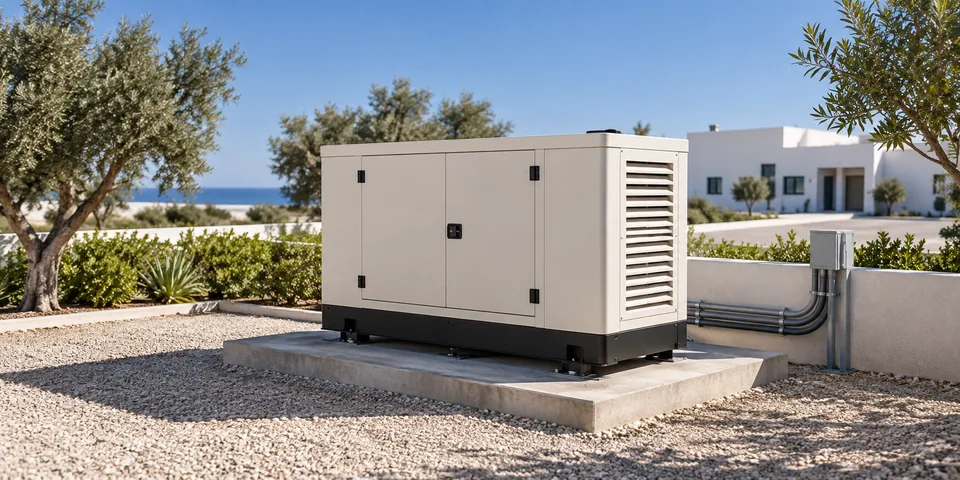
The choice depends on the appliances to maintain, desired duration and tolerance to interruption. A sensitive till, a refrigerated display and a heating appliance do not need the same service. Batteries, UPS and generators can meet different needs or be combined in a carefully designed architecture.
The first step is to describe your operations during an outage. Do you want to save a transaction, keep essential services running for a few hours or power a substantial load for a long period? The answer guides sizing.
Key points: power and runtime are checked separately; a fast transfer is not automatically compatible with every appliance; a combined solution requires an overall design.
1. Clarify the term “inverter”
A solar PV inverter converts the electricity produced by panels. This does not mean it can power a business when the grid goes down. Backup operation depends on the equipment, energy reserve and planned architecture.
An uninterruptible power supply, often called a UPS or ASI, is designed to protect powered equipment. Several architectures exist. Eaton explains that double-conversion models can maintain output when switching to battery, while other categories have a transfer time that must be checked against the loads. Source: UPS functions, Eaton.
This distinction avoids choosing equipment solely because its French name includes “onduleur”.
2. Compare useful functions
| Solution | Common need assessed | Limits and checks |
|---|---|---|
| UPS/ASI | Till, local network, IT or sensitive equipment | Power, architecture, runtime and actual compatibility. |
| Battery with a suitable inverter | Several priority circuits for a defined period | Available energy, peaks, transfer, recharging and reserve. |
| Generator | Extended supply or substantial loads | Startup, fuel, noise, exhaust, maintenance and output quality. |
| Combined architecture | Immediate continuity followed by extended operation | Source coordination, protection, settings and testing. |
This table describes possible uses, not a universal ranking. A small UPS does not automatically replace a battery intended for several hours of refrigeration. A large battery is not necessarily a suitable UPS for highly sensitive electronics.
3. Start with two separate calculations
In a fictional example, priority circuits draw an average of 1 kW and must run for four hours. Demand at the appliances is 4 kWh. With 80 % of nominal capacity usable and assumed overall efficiency of 90 %, the calculated energy minimum is 4 ÷ (0,80 × 0,90) ≈ 5,56 kWh of nominal capacity.
Simultaneous power and peaks must then be checked. A motor may demand more at startup than during normal operation. The inverter and battery capabilities must jointly meet these demands. Source: inverter/charger sizing guide, Victron.
Generator, UPS or battery power therefore cannot be selected from a monthly bill average alone.
Specify “business backup power”, your equipment and desired duration. The team contacts you using your name, phone number and email to prepare a free, no-obligation assessment.
4. Plan transfers between power sources
A generator must start and reach the necessary conditions before powering appliances. A battery reserve or UPS can be considered to cover this interval and protect certain loads.
Transfers vary between devices. Documentation for the Victron VE Transfer Switch, for example, indicates an interruption while changing source. This applies to that specific product and shows why transfer must be checked in the chosen configuration. Source: VE Transfer Switch operation.
The assessment also plans for grid restoration, appliance restarting and recharging. Tests must use the equipment actually operated by the business.
5. Assess location and operation
A battery and its associated equipment need an environment compliant with their manuals, protection devices and maintenance access. A generator also requires fuel and exhaust management.
A portable combustion generator must never run inside the business, a back room, garage or partly enclosed space. Its outdoor location must protect occupants from exhaust fumes and remain away from openings and air intakes. Carbon monoxide is a major hazard. Source: CDC, preventing generator-related poisoning.
Connection to building circuits and coordination of sources require professional design and installation. The project must prevent any uncontrolled energy backfeed to the grid.
6. Compare the complete budget
Compare initial cost, energy or fuel, maintenance, tests, replacements and financing. Backup can protect operations without reducing electricity bills; solar can add savings during normal operation. The two effects are assessed separately.
In Tunisia, connection and selected equipment are reviewed under the framework applicable to your use, including the STEG technical reference of July 2026. The domestic storage announcement does not automatically validate every commercial project.
Read the café case, refrigeration protection and outage cost calculation. Our business and cash/credit profitability pages complete the analysis.
Also browse all our solar PV advice.