
Solar panels for businesses in Tunisia
Make the most of your roof and lower your electricity costs. Your study is based on your business consumption, operating hours and site connection.
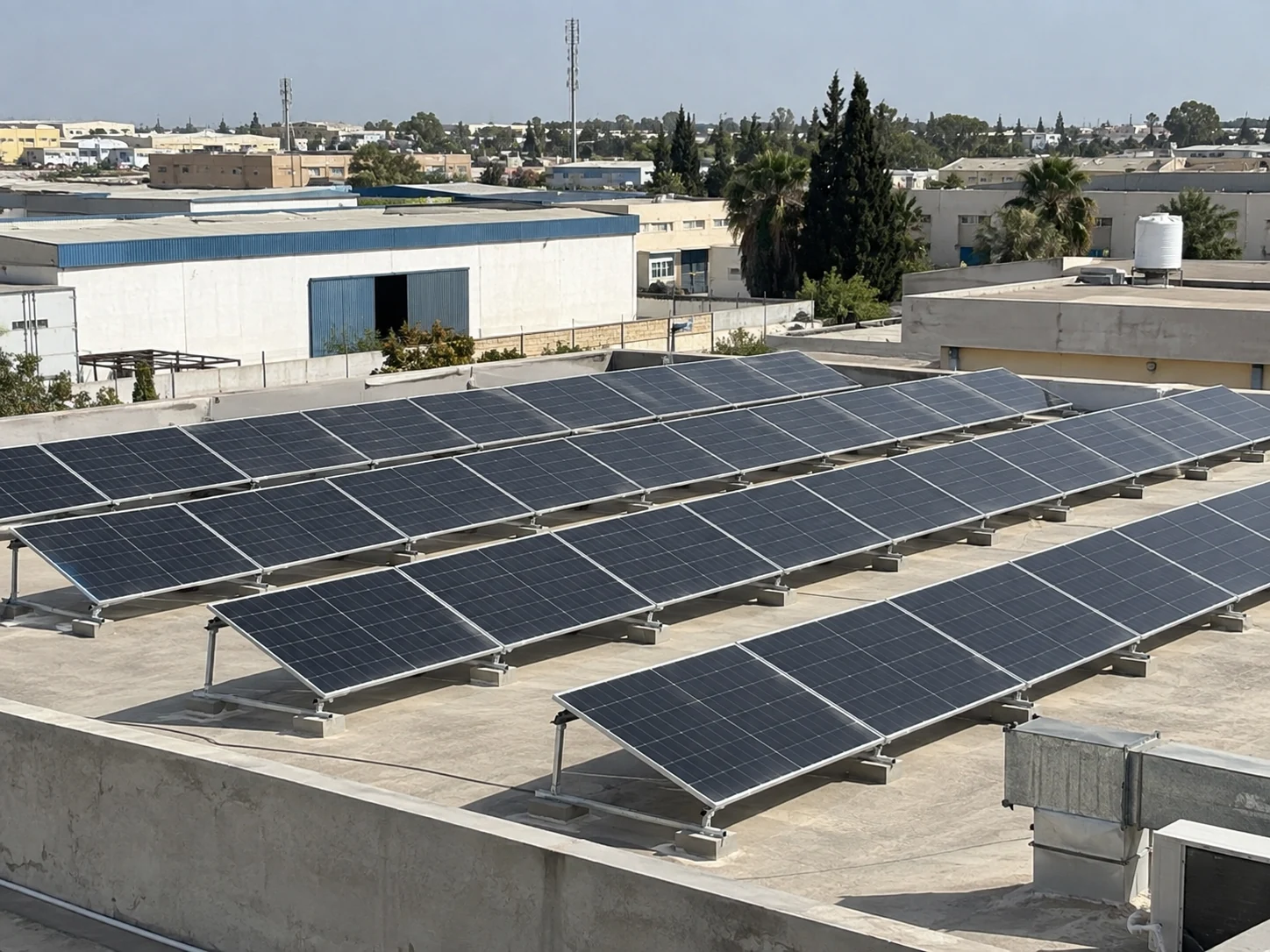
Can a factory run entirely on solar power during the day?
Yes, at a given moment, if solar generation covers its electricity demand. A factory can also use all its solar generation while still drawing electricity from the grid: consuming 100 % of generation and covering 100 % of needs are different outcomes.
| Factory demand | Solar generation | Grid exchange |
|---|---|---|
| 20 kW | 15 kW | 5 kW drawn from the grid; all solar generation is used. |
| 20 kW | 20 kW | No electricity drawn at that moment. |
| 20 kW | 25 kW | 5 kW of surplus to manage according to the connection and contract. |
Clouds, machine start-ups and shutdown days change this balance. Subscriptions and other applicable charges remain: drawing no grid power at certain times does not mean a zero total bill.
Low-voltage factory: capacity and netting
The STEG LV contract reviewed requires installed capacity to be no greater than subscribed capacity, with prior approval for any change. Billing is based on the balance between electricity drawn and injected; any surplus carries forward to the next cycle. Your installation's specifications are validated in the connection application. Source: STEG LV contract, articles 3 and 11.
Medium-voltage factory: using solar and managing surplus
The 30 % limit described in the MV/HV self-generation scheme concerns sales of annual surplus generation. It does not cap the solar electricity consumed directly by the factory at 30 %. Transmission, carry-forward and surplus purchases are assessed under the applicable contract. Source: ministry — self-generation scheme.
To size your project, we review twelve months of bills, operating hours, shutdown days, subscribed capacity and, where available, the load profile. The chosen capacity aims to maximise economic value while maintaining technical suitability.
Which profile fits your business?
Industry / manufacturing
Daytime consumption and industrial needs: assessment of the load profile and connection.
Farm
Pumping, irrigation and refrigeration: assessing schedules and needs helps determine the value of solar.
Retail / services
Air conditioning and refrigeration create daytime peaks, with roof space available.
Property / logistics
Large unused roofs ready to generate energy.
Sizing based on your actual load profile
The right size is not the largest: it is the one that maximises self-consumption. We use 12 months of STEG bills and your load profile to find the optimal balance between investment and savings.
Self-consumption or selling to STEG?
Self-consumption (the main approach): you generate and consume on site. Your saving is the STEG retail price avoided for each kWh consumed. The study compares savings according to schedules and project conditions.
Surplus valuation: electricity fed into the grid is credited under the rules in force, within certain limits. We assess the framework applicable to your site.
LV or MV?
The study checks whether your site connects at low or medium voltage and whether it has a transformer substation. The technical application and procedures are prepared accordingly.
An investment, not an expense
Return on investment depends on daytime consumption, your kWh price and your self-consumption rate. Your study sets out the budget, estimated generation, consumption assumptions and indicative payback period.
Reliability & maintenance
Maintenance contract: generation monitoring, cleaning and periodic electrical checks. A dirty panel or faulty inverter means unnoticed lost savings; monitoring protects your yield. Warranties (modules, inverter, installation) are specified in your quote according to the selected equipment.
Frequently asked questions
Financing, generation, procedures: prepare your installation with the essential information.
Ask a question about my projectMy business needs a medium-voltage connection: is that more complicated?
LV or MV depends mainly on the presence of a transformer, not just capacity. MV adds administrative steps, which we handle from start to finish. We assess the framework applicable to your site.
How long is the payback period?
That depends on your consumption, the kWh price you pay and your self-consumption rate. We calculate your estimated payback period in your personalised quotation.
What happens at night or without sunshine?
The STEG grid takes over. Self-consumption complements the grid; it does not disconnect you from it.
How much can your business save?
Get a free profitability study based on your actual consumption. No obligation.