
Solar batteries in Tunisia: what STEG provides for in 2026
Residential storage, lithium or lead-acid batteries and hybrid inverters: the 2026 STEG documents to check when planning your installation.
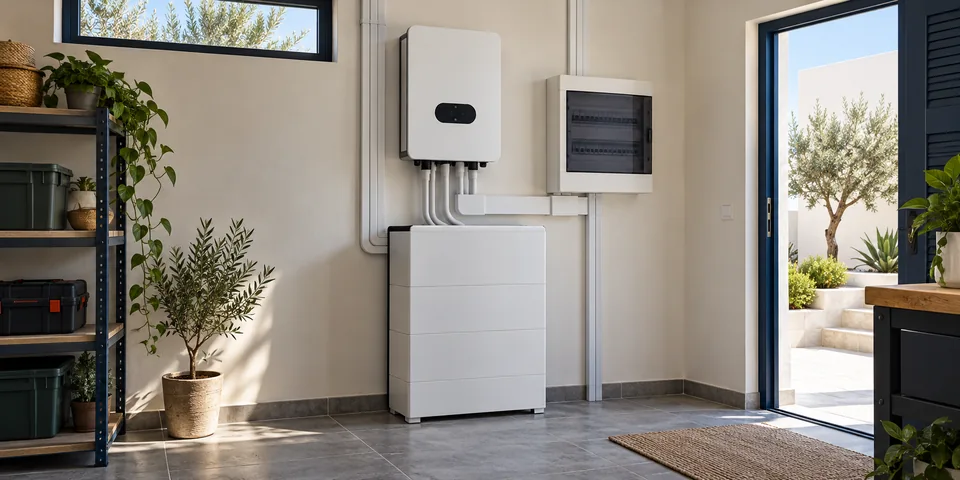
STEG explicitly provides for residential solar PV storage, subject to technical conditions. Its announcement authorises residential customers to install batteries paired with hybrid inverters. The project still needs to be defined using equipment references, compatibility and connection requirements.
Three verified reference points:
- A STEG announcement expressly concerns residential customers.
- The low-voltage technical reference is dated July 2026 and covers storage.
- A list of accepted hybrid inverters is published in an August 2026 version.
Document check: 31 October 2026. Applicable conditions are confirmed for each application before installation.
A residential announcement, a technical reference and an equipment list
These documents answer different questions. STEG’s announcement sets out the possibility of installing residential storage; the technical reference specifies system requirements. Source: STEG announcement on home batteries, accessed 31 October 2026.
The reference describes design and integration requirements. The list specifies inverter models and their acceptance validity. These technical documents must not be presented as a new general law authorising any battery.
| Document to check | What it establishes |
|---|---|
| STEG announcement on domestic storage | The announced residential scope. |
| July 2026 low-voltage reference | The technical framework for the proposed system. |
| Hybrid inverter list, August 2026 version | The inverter model and its acceptance. |
| Manufacturer documentation | Compatible batteries and system functions. |
Are gel and lithium batteries covered?
The reference cites lithium-ion and sealed lead-acid technologies, including OPzV and AGM; its description also mentions gel electrolyte. It requires a justified choice and compatibility with the inverter. This does not automatically accept every product labelled “gel” or “lithium”. Source: STEG reference, pages 67 and 68.
In practice, the right question is: which exact battery works with which inverter, for which need? SMA documentation illustrates this distinction: some of its devices support different battery families, while others require compatible lithium batteries approved by the manufacturer. These are model-specific conditions, not a Tunisian rule shared by all brands. Manufacturer source: battery compatibility.
Check the exact inverter model
The STEG list consulted is titled “V1 — August 2026”. It presents SOLIS and SMA references, AC power ratings and acceptance expiry dates. Compare the full model proposed, not just its brand. Source: official hybrid inverter list.
The full list and each model’s acceptance validity must be checked when preparing the application. A recognised brand does not replace acceptance of the exact model.
Add your bill and specify your goal: reducing bills, using more energy in the evening or powering priority appliances. The team uses this information for a free, no-obligation assessment.
What about a café, shop or factory?
The cited announcement concerns residential customers. For business premises, the project framework must be confirmed according to its connection, contract and chosen configuration. Large grid storage projects and their tenders do not, on their own, constitute individual authorisation for a business.
To prepare for the discussion, gather your bill, operating hours, priority equipment, desired backup duration and details of equipment already installed. The technical review will specify any additional documents needed. You can also consult our business profitability example to distinguish savings from financing.
Plan for actual operation, not just capacity
The application must specify battery safety, protection and integration. The reference covers disconnection protection, lithium battery management systems and documentary acceptance criteria. Source: STEG reference, pages 53, 69 and 75–76.
A 10 kWh battery therefore does not, on its own, define which appliances will run during an outage. The uses, available power and backup behaviour must be specified. Our guide to solar during a STEG outage explains these choices.
To describe developments in 2026 accurately, we rely on verified documents: the announcement, technical reference and equipment list. Our research did not identify a separate new law broadly authorising all gel and lithium batteries.